HOLE IN THE WALL
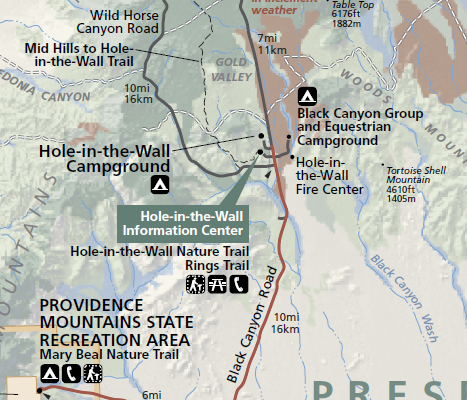
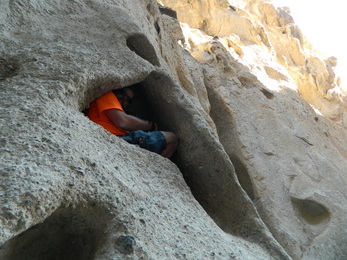
Hole In the Wall
|
|
Woods Mountain Volcanic Center
- A Middle Miocene silicic caldera complex
- Felsic to intermediate magmatism is associated with crustal extension
- It is one of the most distinctive centers of Miocene magmatism in the Mojave Desert, in two ways:
- It is the only center in the region where a large volume of peralkaline high-silica rhyolite magma was extruded.
- It is distinguished by an unusually low intensity of middle to late Miocene faulting.
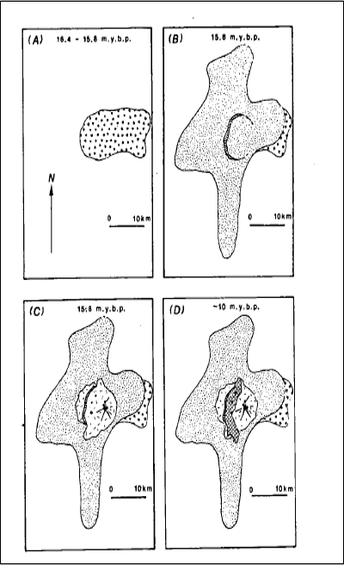
Evolution of the Woods Mountain Volcanic Center
|
A. First Erupted Hackberry Spring Volcanics (Triangle Pattern)
B. Formation of Caldera and pyroclastic flow = outflow of the Wild Horse Mesa Tuff (Dot Pattern) - Initial eruptions covered the region with up to 200 meters volcanic flows and tuff. C.+ D. Extrusion of Tortoise Shell Mountain Ryholite (Stipple Pattern) = collectively lava flows, tephra and caldera scarp breccia Solid Black lines indicate rhyolite plugs of Tortoise Shell Mountain Rhyolite - The erupted material covered an area of 600 km² - It exploded material that was 14-20 meters across |
|
Woods Mountain Volcanic Center Caldera Margin
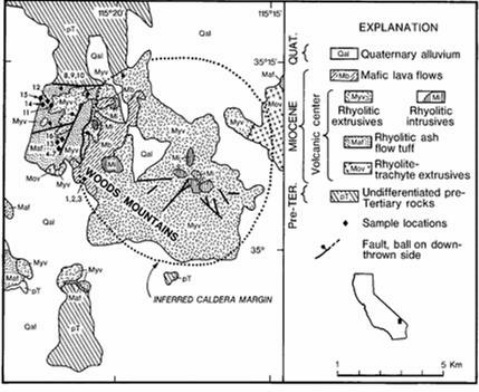
10 kilometer diameter
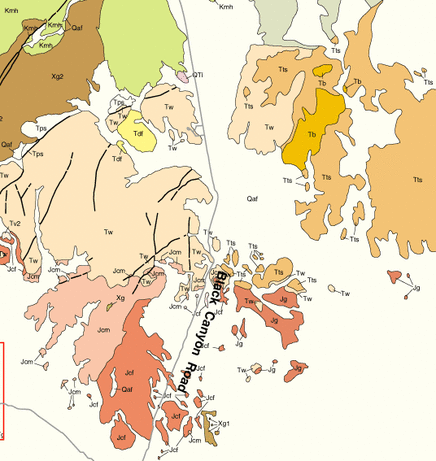
Geologic Map
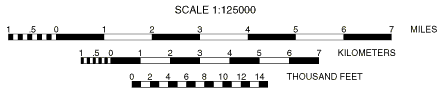
|
Key Geologic Map Units Tts: Tortoise Shell Mountain Rhyolite Tw: Wild Horse Mesa Tuff Ths: Hackberry Spring Volcanics (Not Shown) |
Cross-Section of the Woods Mountains Volcanic Center
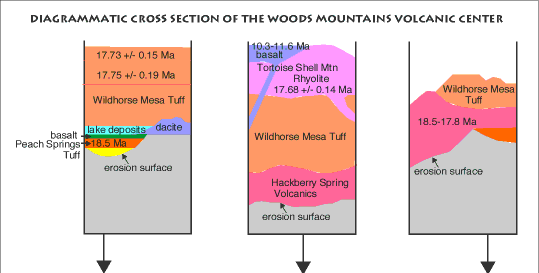
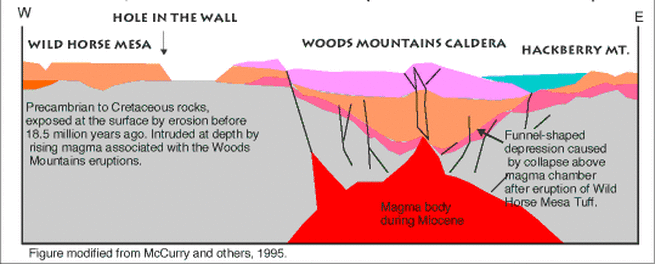
Citation: McCurry, M., Lux, D. R., and Mickus, K. L., 1995. Neogene Structural Evolution of the Woods Mountains Volcanic Center, East Mojave National Scenic Area: San Bernadino County Museum Association Quarterly, v. 42, no. 3, p.75-80.
Hackberry Spring Volcanics

- Made up of interlayered lava flows, domes, ash flows, and dikes and plugs
- Compositions range from trachyte, trachydacite, and rhyolite.
- Dated at about 16 Ma (McCurry, 1988).
- Crops out widely on Hackberry Mountain
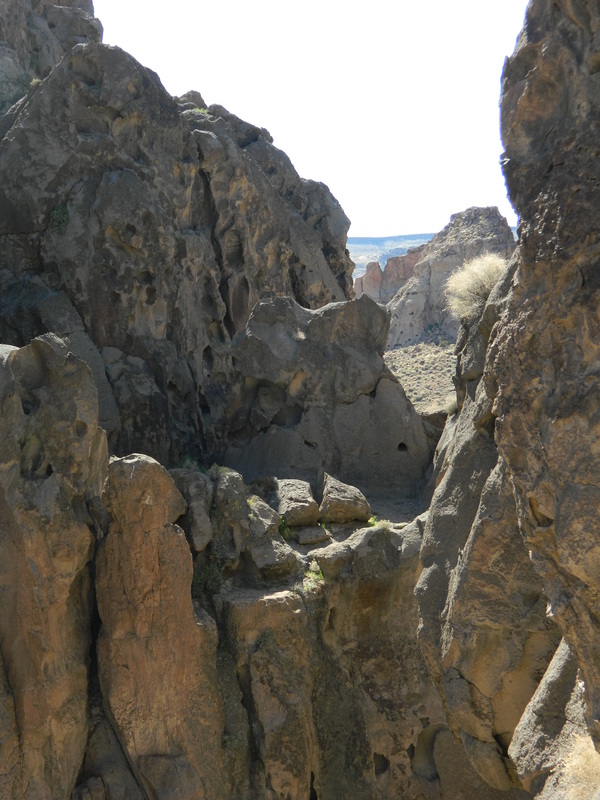
Wild Horse Mesa Tuff
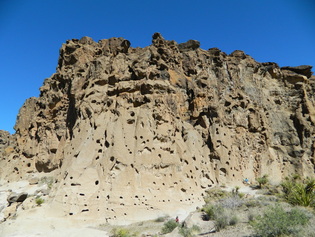
- Comagmatic (having minerals/chemical features indicating a similar magmatic source) sequence of dominantly rhyolitic ash-flow tuffs: consists of 61-76% Silica
- Forms conspicuous (easy to see) mesas in Woods Mountains area.
- Deposits vary from 20 to 320 m thick and have a distinctive layer-cake appearance
- Prominently layered sanidine rhyolite ash-flow tuff containing common sanidine phenocrysts
- Dated at about 15.8 Ma (McCurry, 1988).
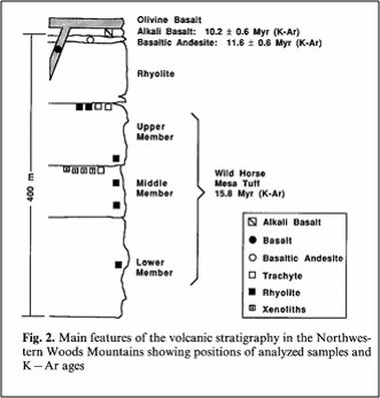
- It is divided into lower, middle and upper members on the basis of:
2. Phenocryst assemblages and abundance
3. Whole-rock chemical composition
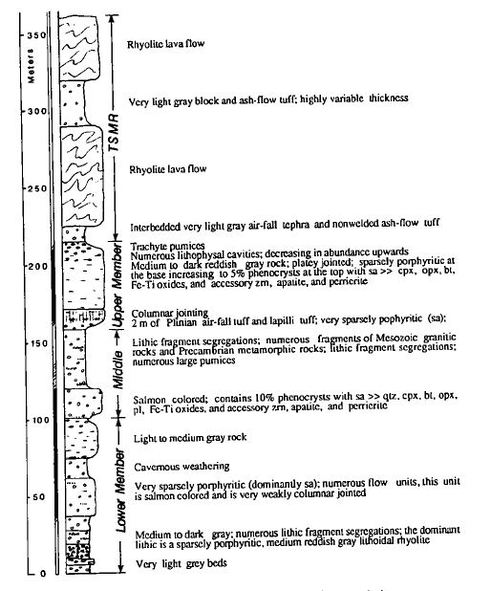
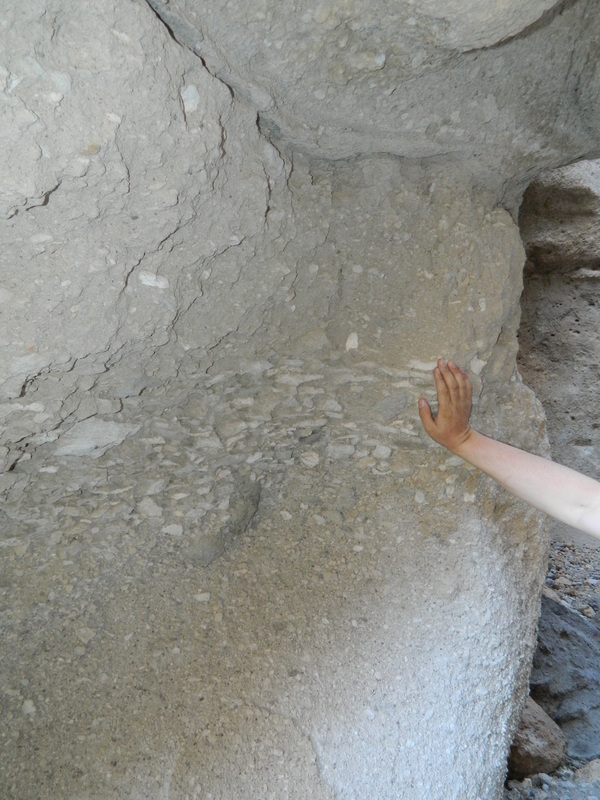
- Contacts are primarily distinguished by moderately sorted tuff at the base
- Ash cloud deposits occur at the tops
- Ground surge deposits occur at the base of some of the flow units
- Each member is interpreted to have been emplaced in a single major eruption
|
|
Tortoise Shell Mountain Rhyolite
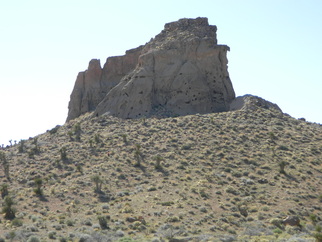
- Consists of rhyolite lava flows and plugs, and interbedded pyroclastic material.
- Aphyric to porphyritic with sparse sanidine.
- Rhyolite is dated at 15.8 Ma (McCurry, 1988) and is chemically similar to the upper cooling unit of the Wild Horse Mesa Tuff
Sources
Cole. J.W et al. “Calderas and caldera structures: a review.” Earth Science Reviews. 69 : 1-26 (2005)
Dokka, Roy K., McCurry Michael. “A Field Guide to the Cenozoic Crustal Structure of the Mojave Desert.”
<http://www.muststayawake.com/SDAG/library/Dokka_Mojave(FeildGuide).pdf>
Maley, Terry S. Field Geology Illistrated. Boise, Idaho: Mineral Land Publications, 2005. Print.
Musselwhite, D.S., Paolo, D.J., McCurry, M. “The evolution of a silicic magma system: isotopic and chemical evidence from the Woods Mountain Volcanic Center, eastern California.” Contributions to Mineralogy and Petrology. (1989) 101: 19-29
US Geological Survey. “Geology of Mojave: National Preserve.”
http://www.nature.nps.gov/geology/usgsnps/mojave/holemap.html
Winters, John D. Principles of Igneous and Metamorphic Petrology. Upper Saddle River, New Jersey: Pearson Prentice Hall, 2010. Print.
Dokka, Roy K., McCurry Michael. “A Field Guide to the Cenozoic Crustal Structure of the Mojave Desert.”
<http://www.muststayawake.com/SDAG/library/Dokka_Mojave(FeildGuide).pdf>
Maley, Terry S. Field Geology Illistrated. Boise, Idaho: Mineral Land Publications, 2005. Print.
Musselwhite, D.S., Paolo, D.J., McCurry, M. “The evolution of a silicic magma system: isotopic and chemical evidence from the Woods Mountain Volcanic Center, eastern California.” Contributions to Mineralogy and Petrology. (1989) 101: 19-29
US Geological Survey. “Geology of Mojave: National Preserve.”
http://www.nature.nps.gov/geology/usgsnps/mojave/holemap.html
Winters, John D. Principles of Igneous and Metamorphic Petrology. Upper Saddle River, New Jersey: Pearson Prentice Hall, 2010. Print.
